NYC Repipe & Repair handles repiping Queens rowhouses, two-families and detached houses, and finds and fixes the leaks that usually show up first. Queens grew between the wars: city property records put 59% of its one- to four-family lots in the years 1920 to 1949, and many of those houses still run on their original galvanized steel supply. Every repipe is Type L copper, the material the NYC Plumbing Code calls for, filed in DOB NOW by a NYC Licensed Master Plumber and priced in writing before work is booked.
What repiping in Queens actually involves
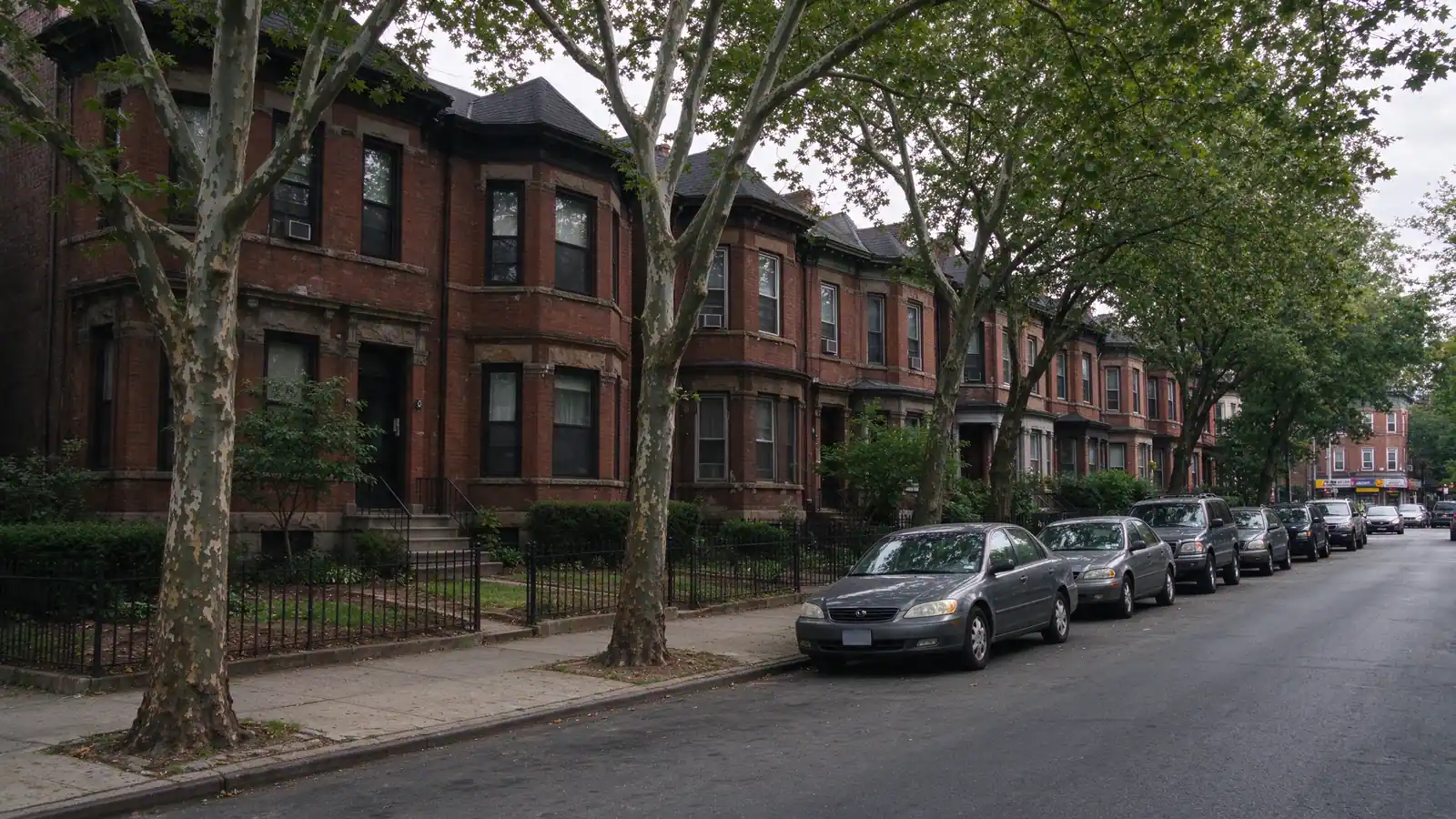
Repiping in Queens follows the borough's interwar building boom. City property records put the median one- to four-family house at 1935, with 59% built between 1920 and 1949. Along the 7 train that means the attached brick rows and two-families of Sunnyside, Woodside and Jackson Heights, where the Queensboro Corporation coined the term "garden apartment" and kept building into the late 1930s (Wikipedia: Jackson Heights). Astoria's two-families and the brick rows of Middle Village come from the same decades. Galvanized steel was the standard supply pipe for that whole period, and its typical working life is 40 to 60 years, so most of it is overdue. DOB NOW shows 330 Queens water-repipe filings and 173 riser filings since January 2023. Leaving aside NYCHA's Queensbridge Houses, Forest Hills and central Astoria lead the borough's list.
Ridgewood is its own case. Most of its yellow-brick rowhouses went up between 1905 and 1915, and the three-story Mathews Model Flats of the Ridgewood North Historic District date from 1908 to 1914 (Wikipedia: Ridgewood). Ridgewood North and South are city landmark districts, as is Jackson Heights, so permitted interior plumbing there generally needs a Landmarks Preservation Commission Certificate of No Effect. In a three-story flat the supply climbs past every apartment, so the work is planned floor by floor and each unit is normally back on water at the end of each working day. Forest Hills Gardens is different again: Tudor Revival houses built mostly between 1910 and 1917, designed by Grosvenor Atterbury and assembled from roughly 170 precast concrete panels each (Wikipedia: Forest Hills). Concrete walls leave few easy chases, so the copper route is mapped through cellars, closets and the original pipe paths before anything is opened.
The street side matters in Queens too. Lead service lines were legal in NYC until 1961, and the owner owns the whole line from the main to the house. DEP's free program, which swaps lead or galvanized service lines for copper, moved into Flushing, Murray Hill, Queensboro Hill and East Flushing after its first Bronx phases (Governor's announcement). Only owners who receive a DEP postcard or flyer qualify, so check the service line map before paying privately; a private replacement typically costs $5,000 to $10,000 (NYC DEP lead service line plan). Where an owner pays, the front-yard or driveway service line is often replaced alongside the interior repipe, with DEP and DOT permits for the street opening. Further east, Bayside's detached houses run from the 1920s to the 1950s, and the job looks like a standard whole house repiping of a one- or two-family. If the first symptom is rust at the tap, start with why tap water turns brown.
What goes wrong in Queens houses
Brown water in an interwar two-family. Rust-colored water at the first draw of the morning, worst after the water has been shut off. Galvanized steel from the 1920s to the 1940s corrodes from the inside, and soft, corrosive city water keeps it going.
A weak shower upstairs. The second-floor apartment loses pressure whenever the kitchen below runs. Scale has narrowed the pipe, and both households often share one service line and one riser.
Galvanized or lead under the front yard. DEP's free service-line program covers only owners who get a DEP postcard or flyer. Everywhere else in Queens, the owner pays to replace their own line from the street main.
A cellar full of patches. Unions, short copper splices and clamps on old galvanized. Each fix holds until the next corroded thread lets go, and the cellar ceiling becomes a map of past leaks.