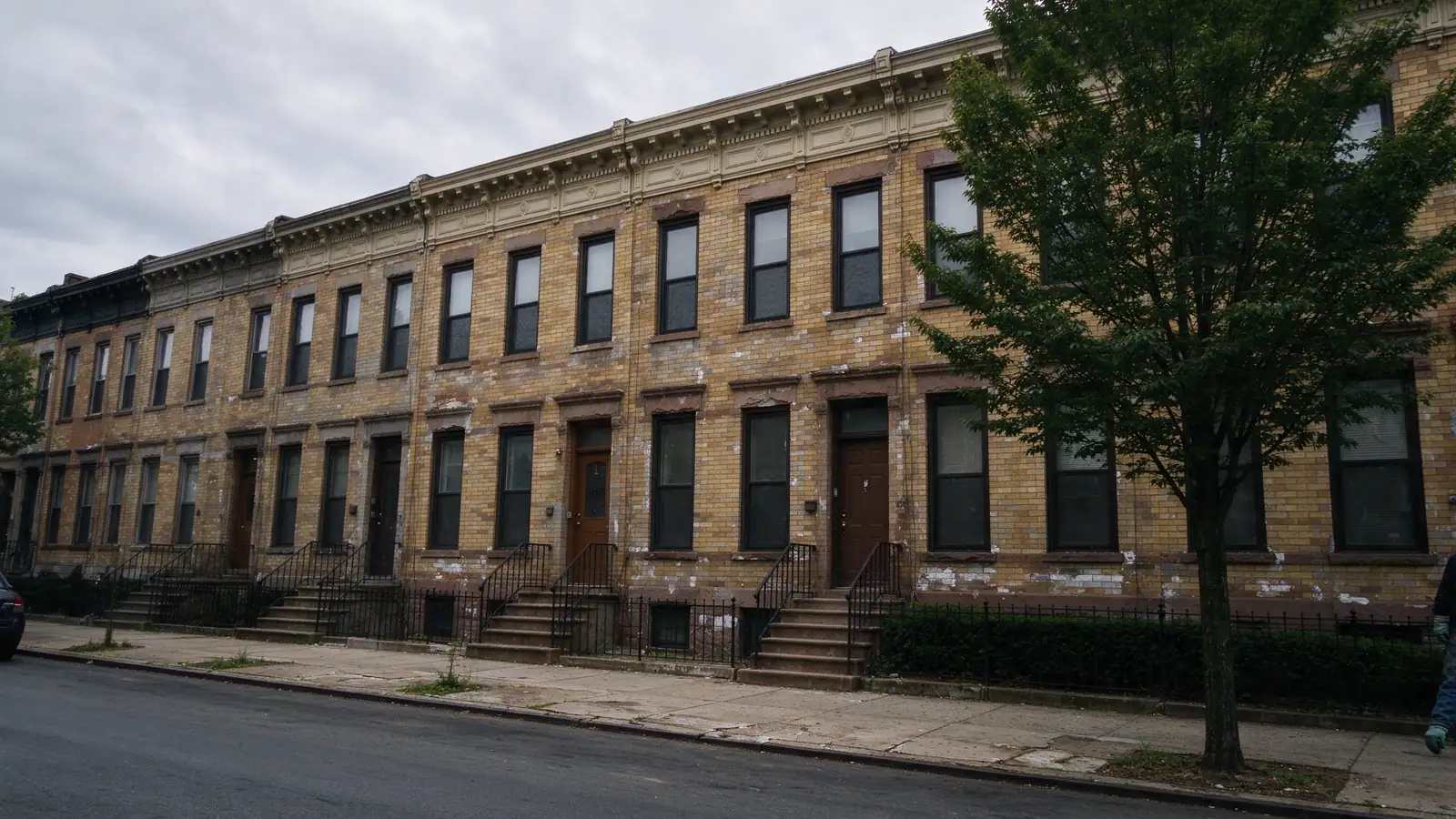
NYC Repipe & Repair handles repiping Ridgewood buildings need, from three-story Mathews flats with six apartments to curved Stier two-family rowhouses and the brick rows of Stockholm Street. Most were built between 1905 and 1915 on galvanized steel supply, and many began as cold-water flats with hot water added later. Each job replaces that piping in Type L copper with tenants kept on water, filed in DOB NOW with an LPC Certificate of No Effect inside the historic districts, and priced in writing first.
What repiping in Ridgewood actually involves
Ridgewood was built nearly all at once. Masonry construction became mandatory in 1905, the Queensboro Bridge opened in 1909, and most of the neighborhood's housing went up between 1905 and 1915 in amber and yellow face brick. Builders like the G.X. Mathews Company, with architect Louis Allmendinger, produced the three-story Mathews flats, with two apartments per floor. Louis Berger & Co. designed more than 5,000 buildings in the area. The city has since landmarked big pieces of it: Stockholm Street (2000, 36 rowhouses on the neighborhood's last brick-paved street), Ridgewood North (2009, 96 buildings built 1908–1914), Ridgewood South (2010, 210 buildings) and Central Ridgewood (2014, 990 buildings) (Wikipedia). Many Mathews flats began as cold-water tenements, with hot water added later, so one building can hold supply piping from two different eras, each failing on its own schedule.
A Mathews flat is a small multifamily job, not a house job. One service line and one set of risers feed six apartments over three floors, all under street pressure with no roof tank, so a corroded riser shows up as weak flow and brown water on the top floor across the whole stack. Patching a pinhole in one apartment rarely holds when the riser behind it is the same age. The work is planned as a riser replacement plus new branches, done stack by stack so each apartment is normally back on water at the end of the day. Because these are three-plus-family buildings, DOB's LAA fee is $195 up to $3,000 of work plus $10.30 per $1,000 after that. Unpermitted work carries a penalty starting at $6,000, compared with $520 for a one- or two-family house. Inside the landmark districts, the filing also needs an LPC Certificate of No Effect. Two-family Stier and Ring-Gibson houses follow the two-family approach instead.