NYC Repipe & Repair replaces failing sections of water supply pipe in New York City homes: one corroded run, the piping on a single floor, or the lines that feed one bathroom or kitchen, in Type L copper. Pipe replacement on this scale is the right call when the damage is local and the rest of the system tests sound. It costs far less than a full repipe and opens far fewer walls. When pressure readings and material checks show the problem runs through the whole house, the written estimate says so plainly.
What happens on the first visit
- Pressure readings at the meter and on the affected run, compared with the floors above and below.
- Pipe material identified on both sides of the failing section, so new copper only joins pipe worth keeping.
- The start and end points located: a riser tee, a branch takeoff or a shutoff valve, which sets how far the replacement reaches.
- A written, itemized price that says whether the job is ordinary plumbing work or needs a DOB NOW filing, before anything is booked.
When a partial replacement makes sense
A single run can fail for reasons unrelated to the rest of the house: a section frozen in an exterior wall, a branch patched with mismatched fittings, or one stretch of galvanized left behind when the rest went to copper. Then pipe replacement on one run, one floor or one bathroom fixes the cause without opening every wall.
The test is whether the problem is local. Partial replacement is the right call when:
- Pressure is normal everywhere except the affected fixtures. If the top-floor shower and the basement sink read the same as the meter, the risers are doing their job.
- The pipe on both sides of the failure is sound. Copper that is clean inside, or galvanized that was already replaced elsewhere, is worth connecting to.
- The leak history points to one place. Three leaks on the same bathroom branch is a branch problem. Three leaks on three floors is a system problem.
- The walls are already open. A kitchen or bathroom renovation is the cheapest moment to replace the lines behind it. See repiping during renovation.
If the leak itself is the question, start with water leak detection or pipe repair.
Where the new copper starts and stops
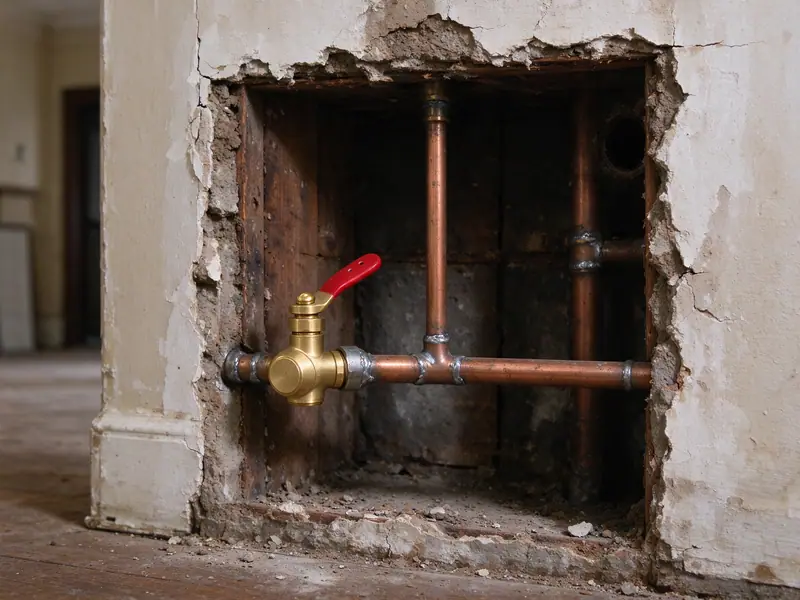
A partial job lives or dies at its ends. The new section should begin at a new full-port shutoff valve at a riser tee or branch takeoff, and end at the fixture stops. Stopping halfway along a corroded line just moves the next leak a few feet down the wall.
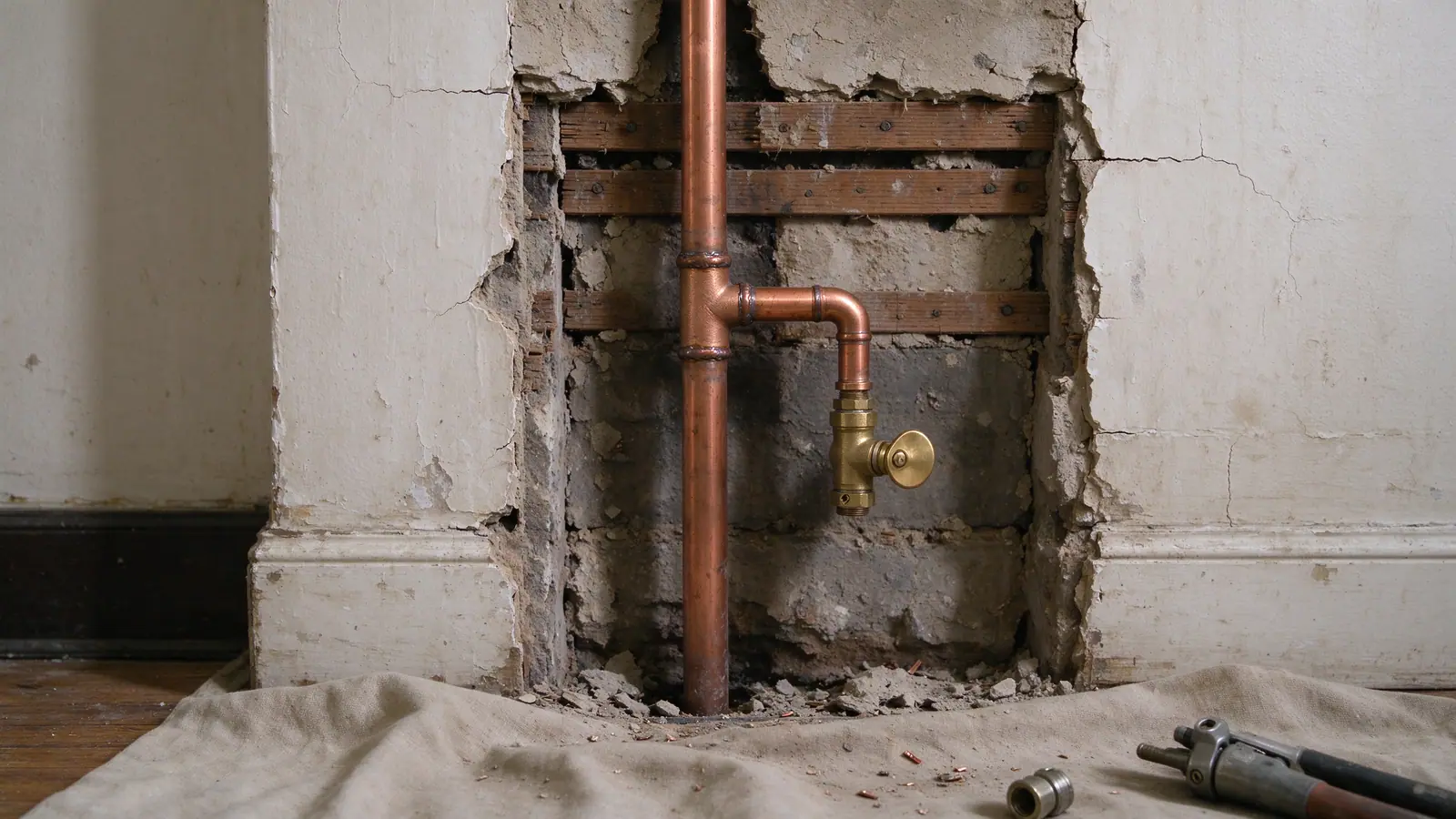
The 2022 NYC Plumbing Code sets the rules for both the pipe and the joints. Table 605.4 lists copper tubing Types K and L for water distribution, not PEX, CPVC, galvanized steel or Type M copper. Removable push-fit fittings are prohibited (PC 605.9), so the joints are soldered or made with permanent press fittings. Where new copper meets old galvanized, PC 605.24.1 requires a brass fitting, a dielectric fitting or an ASSE 1079 dielectric union to stop galvanic corrosion at the joint. Copper vs PEX in NYC explains why the cheaper national options don’t apply here.
Permits and what drives the price
DOB treats repair or replacement of non-gas piping no longer than 10 feet as ordinary plumbing work: no permit, with the Licensed Master Plumber reporting it on form OP128. Anything longer, such as a floor’s worth of branches or a bathroom’s supply, is filed in DOB NOW: Build as a Limited Alteration Application.
The filing fee is small. On a one- to three-family house, DOB’s LAA fee chart starts at $130 for work up to $5,000, plus $2.60 per additional $1,000. In co-ops, condos and buildings with four or more units it starts at $195. Unpermitted work costs more: penalties start at $520 for a one- or two-family house and $6,000 for other buildings. See the permit guide.
The price itself depends on four things:
- Length and number of fixtures on the run.
- Access: an open basement ceiling is quick; a run buried in a tiled wall is not.
- Wall finish: plaster and lath takes longer to open and restore than drywall.
- Tie-in points: how many transitions to old pipe the job needs.
For full-system numbers to compare against, see how much repiping costs in NYC.
When pipe replacement becomes a repipe
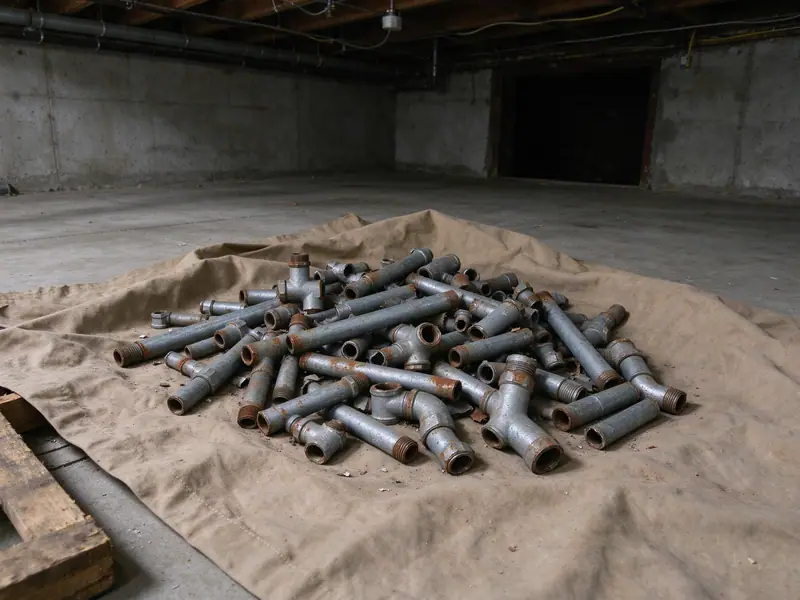
Partial work stops making sense once the pipe beyond the repair is in the same condition as the pipe being replaced. Brown water on every tap, falling pressure on the upper floors and galvanized showing at three or more points all mean the system has reached the end of its life. Galvanized carries a typical working life of 40 to 60 years, and 74% of Brooklyn’s one- to four-family houses were built before 1940. In that case two or three partial jobs usually cost more, in total, than one whole house repiping would have.
The first visit settles it with pressure readings and a material check at several points. For a quick read before calling, try the repipe assessment. Galvanized houses should also read should I replace galvanized pipes? and the galvanized pipe replacement page.
What's included
- Type L copper supply pipe (ASTM B88) for the replaced section
- A new full-port shutoff valve at the start of the run
- Lead-free fittings and valves certified to NSF 372
- Brass or ASSE 1079 dielectric transitions to old galvanized
- Soldered or permanent press joints, never push-fit
- OP128 reporting or a DOB NOW filing by a NYC Licensed Master Plumber
- Pressure test of the new section before walls close
- Water normally restored at the end of each working day
One bad run or a whole system on its way out? Pressure readings on three floors usually answer it in one visit. (929) 659-6658