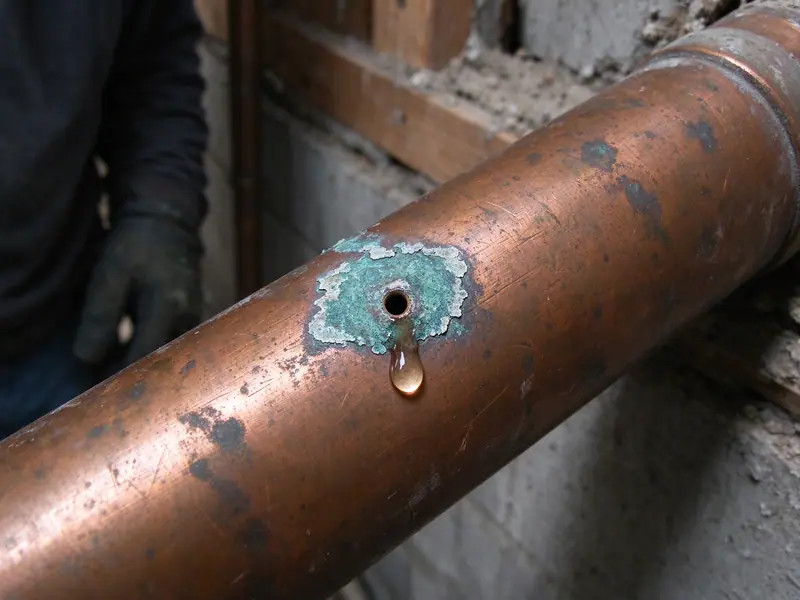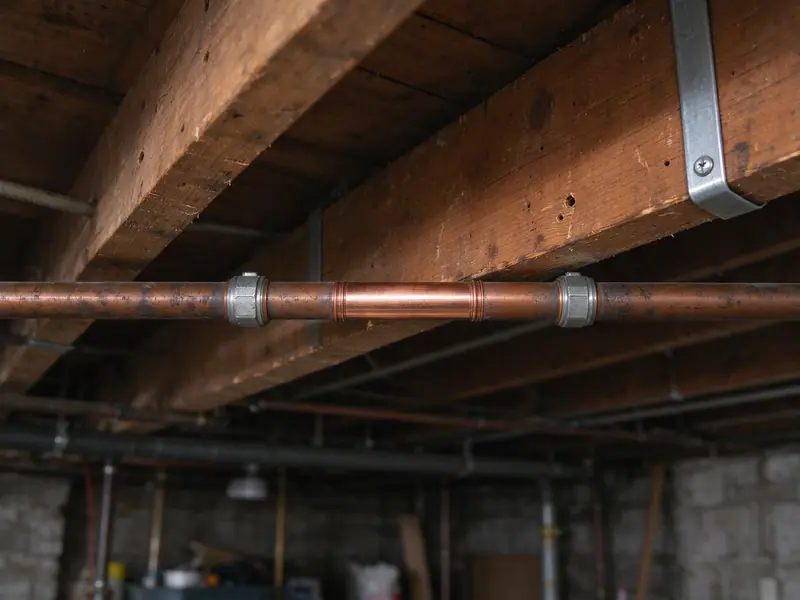
NYC Repipe & Repair repairs leaking copper water pipe in New York City homes: pinhole leaks on hot-water lines, green-crusted joints, and weeping fittings at valves and fixtures. Copper pipe repair here means cutting out the damaged section and replacing it in Type L copper (ASTM B88), soldered or joined with permanent press fittings, never a clamp or push-fit coupling. Because NYC water is soft and corrosive, each pinhole leak repair is also a chance to check the pipe wall around it, so you know whether more leaks are coming.
What happens on the first visit
- The leak located and the copper type confirmed from markings or wall thickness: Type K, Type L or thinner Type M.
- Nearby pipe checked for green staining, weeping joints and further pinholes, especially on hot-water lines.
- Static pressure read at the main valve, since the code requires a reducing valve above 85 psi (PC 604.8).
- A written price for the repair, plus a price for replacing the run if the pipe around the leak is failing.
Why copper leaks in NYC
Copper is the right pipe for New York City, and the only kind of tubing Table 605.4 of the 2022 NYC Plumbing Code lists for water distribution. It still wears out, and NYC water is hard on it. DEP’s annual water quality report puts the average Langelier index at −2.21. A negative value means the water tends to dissolve metal rather than lay down a protective scale. DEP adds orthophosphate, about 2.2 mg/L, to form a film on pipe walls, but a pipe with a thin wall to begin with has little margin.
That is why copper failures cluster in certain houses:
- Thin-wall Type M copper, common in houses built from the 1960s onward. Staten Island is the clearest case: MapPLUTO shows 68% of its one- to four-family lots were built in 1960 or later, with a median year of 1970.
- Hot-water lines, where the most pinholes tend to show.
- Older Brooklyn and Queens houses where galvanized was replaced piecemeal with copper decades ago, leaving mixed-metal joints.
The symptoms are a pinhole spraying a fine jet, green or blue crust on a joint, or a damp spot below a run that has no obvious drip.
How a copper repair is made
A pinhole leak repair in NYC follows the same rules as any water pipe repair:
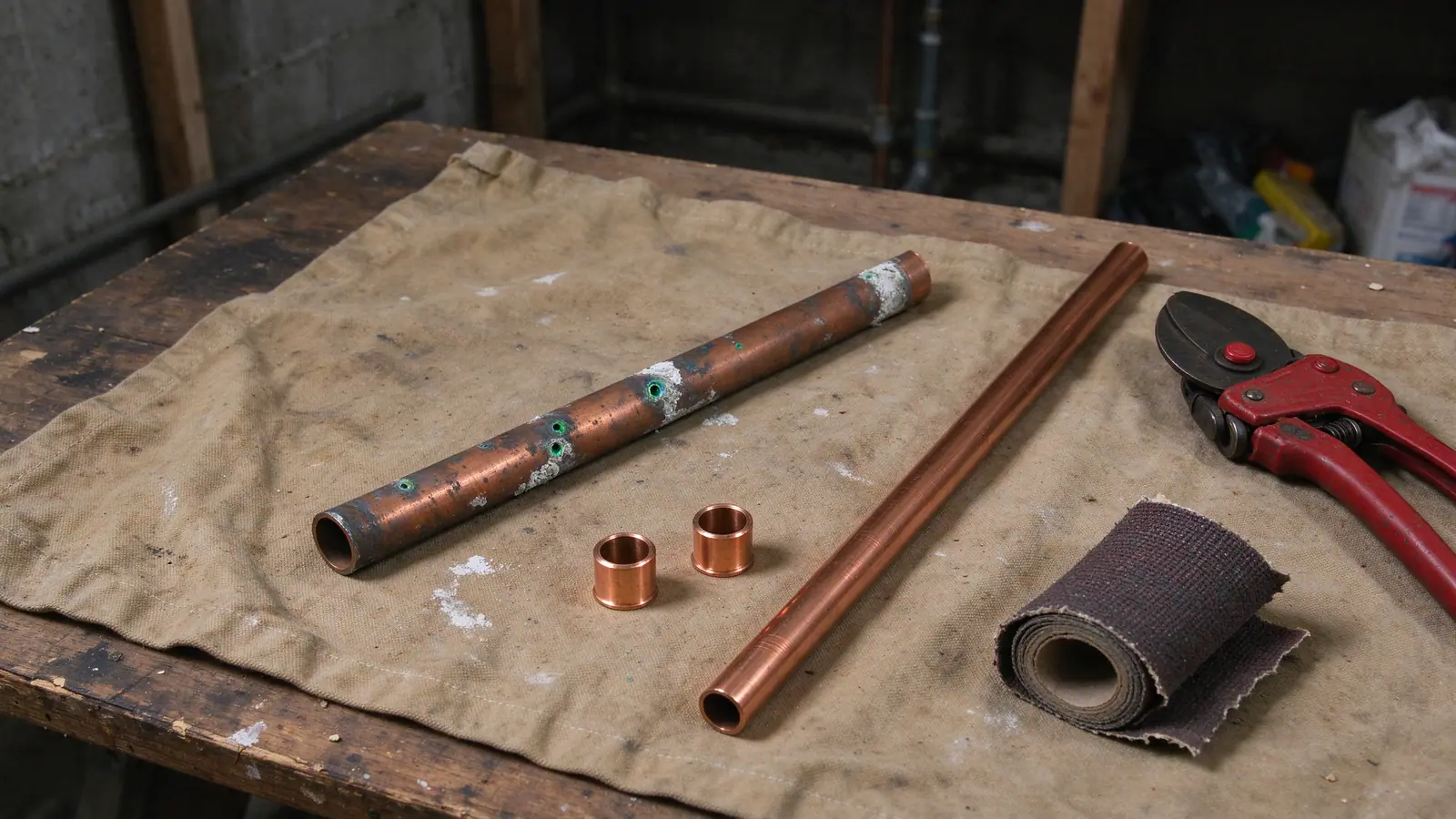
- The pinholed section is cut out back to sound pipe and replaced in Type L copper (ASTM B88), which has a thicker wall than Type M.
- Joints are soldered or made with permanent press fittings using a manufacturer-certified tool (PC 605.14.5). Removable push-fit couplings are prohibited (PC 605.9).
- Fittings and valves on drinking water are lead-free to NSF 372 (PC 605.2).
- Clamps and epoxy are not repairs. PC 701.10 bans epoxy and cured-in-place lining systems outright.
The cut-out section is examined, not thrown away. If the wall is thinned or pitted inches from the pinhole, the next leak is already on its way, and you’ll be shown that. Static pressure is also read. The code caps it at 85 psi, with a pressure-reducing valve required above that (PC 604.8). Type L vs Type K copper explains the wall thickness differences.
Permits and cost drivers
Most copper pipe repair is ordinary plumbing work. Up to 10 feet of non-gas water piping is repaired with no permit filed, and the Licensed Master Plumber reports it to DOB on form OP128. Replacing a longer run moves into a Limited Alteration Application in DOB NOW: Build, explained in the repiping permit guide.
The cost of a copper repair turns on:
- where the pinhole is: an open cellar ceiling, or behind tile or plaster;
- how many leaks turn up once the run is checked;
- access in a co-op, where riser shutoffs are booked through management.
You get a written, itemized price before work is booked. When the run is clearly failing, the estimate also prices replacing it, so the two can be compared. How much repiping costs in NYC and the repipe cost estimator show where a replacement would land.
When pinholes mean the run is done
One pinhole in otherwise sound copper is a repair. A pattern is not:
- a second or third pinhole on the same run within a year;
- pinholes on both hot and cold lines, or on more than one floor;
- a cut-out section showing pitting well beyond the leak;
- Type M copper throughout the house.
Each repair on thinning pipe buys time until the next weak spot, and each one can mean another ceiling repair. Pinhole leaks in copper pipes: repair or repipe covers the decision in depth. The usual next steps are pipe replacement for one bathroom or floor, or whole house repiping in Type L copper when the failures are spread through the house. If the source hasn’t been found yet, start with water leak detection. For leaks in steel rather than copper, see pipe repair.
What's included
- Pinholed or corroded section cut out
- Replacement in Type L copper (ASTM B88)
- Soldered or permanent press joints
- Wall-thickness check on the cut-out section
- Hot and cold lines checked for further pinholes
- NSF 372 lead-free fittings and valves
- Pressure check before close-up
- Written note on the condition of the run
A second pinhole on the same run? The cut-out section shows whether the rest of the pipe is next. (929) 659-6658